
To Trust or Not to Trust
Stefania Lucchetti
On promises, uncertainty, and the courage to rely on someone beyond ourselves.
What does it mean to trust?
We speak of trusting a partner, a friend, a colleague, an institution, an information source—or ourselves. Yet trust remains difficult to define: it involves feeling, judgment, and the courage to accept uncertainty.
Trust is rooted in individual experience. It is not simply an emotion, yet when asked to define it, I find it more elusive than love.
To begin defining trust, we must look towards the future: towards what we expect and believe will happen.
In a relationship, trust may be understood as the expectation that another person’s actions are unlikely to harm us. It is almost as though a psychological contract exists between us and the individual we place our trust in: an understanding of what we can reasonably expect from one another.
Yet trust extends beyond the expectation of avoiding harm. At work, or in a relationship with an adolescent son, it also involves believing that someone will keep a promise or honour a commitment. We may trust a person to act with integrity even when their decisions do not favour our interests.
Trust also shapes our relationship with information: whether we believe an account, accept an explanation, or rely on a source.
We may trust a person, an organisation, an institution, an information system, or, increasingly, an artificial intelligence system. Each involves reliance on something beyond ourselves, though the grounds for that reliance differ. A person’s integrity, an organisation’s accountability, and a system’s reliability require different kinds of evidence.
I have explored trust in several of my books: as an internal experience in Coffee Stains on My Books; through language and communication in The Bricks of the New Babel: Identity, Ethics and Language of Digital Citizenship; and within working relationships in Virtual Teams: Decision Making Dynamics.
What fascinates me is the coexistence of reason and uncertainty. Trust may grow through experience, but it reaches beyond what that experience can guarantee. We trust because someone has acted reliably before, while accepting that we cannot know whether this reliability will continue.
Trust therefore requires vulnerability: we allow another person’s choices to affect us without being able to control them or protect ourselves from every disappointment.
Yet vulnerability alone is not enough. Trust cannot be demanded as proof of love, loyalty, friendship, or professional commitment. Nor can it be sustained indefinitely by promises or good intentions. It is built through communication and confirmed through action.
In Shakespeare’s words: “Love all, trust a few, do wrong to none” (All’s well all that ends well)
Trust is therefore neither purely a feeling nor entirely a reasoned judgment. It is an expectation supported by experience, but also an act of courage: the decision to allow another person’s future actions to affect us when we cannot control what those actions will be.
Trust in working relationships
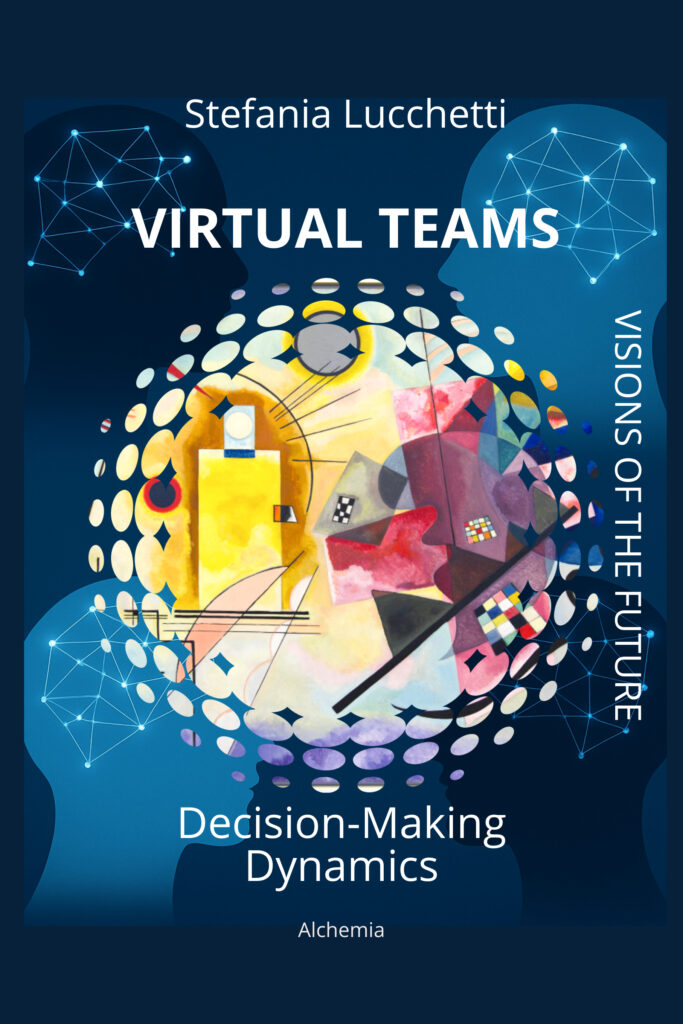 In my book Virtual Teams: Decision Making Dynamics (2024), I considered trust among people who work together without sharing the same physical space.
In a traditional workplace, trust often develops through seemingly incidental contact: a conversation before a meeting, a coffee break, a shared meal, or the opportunity to observe someone under pressure. We become familiar with one another’s habits and ways of communicating, gradually forming expectations about how others will act.
In virtual environments, many of these encounters are absent. We know one another through scheduled calls, written messages, shared documents, and fragments of interaction. We may know what someone produces without understanding the circumstances in which they produce it—or whether they will be available when difficulties arise.
These gaps can lead us to place too much trust in some people and too little in others. Building trust requires clear communication, relevant information, respect for commitments, and support when it is needed. It also requires an environment in which people can ask for help, acknowledge difficulties, or disagree without fearing that their openness will be used against them.
These principles extend beyond the workplace.
Communication gives others access to our thoughts and intentions. Action gives those words credibility. Consistency allows an expectation to form. Over time, we feel less need to monitor or control because we have acquired confidence in how the other person will respond.
Trust in communication, language and sources of information
When we turn from relationships to sources of information, the question changes. We must consider not only whether something is credible, but why it is being communicated and what responsibility accompanies it.
 In chapter 3 of my book The Bricks of the New Babel: Identity, Ethics and Language of Digital Citizenship (2026), I write:
“For centuries, human communication rested upon a tacit yet stable assumption: whoever speaks says something relevant. Words carried weight proportionate to responsibility,
and language was an act that implied intention, relationship, and meaning.
Today this pact has been fractured.
In the digital ecosystem, this principle no longer holds. The overproduction of content, the speed of the network, and the logic of the algorithm have dissolved the connection between word and intention. This happens when we speak (or write) in order to assert our presence rather than to communicate something.
In such circumstances, language becomes a sign of presence rather than a vehicle of meaning: a self-referential gesture, performative and at times empty. Quantity has supplanted quality; reaction has replaced reflection. This shift generates a new form of cognitive alienation: the loss of trust in language as an instrument of shared truth. When everything can be said, nothing truly carries weight.
[..] The continuous production of content does not always arise from a communicative intention; it often responds to a need for presence or visibility. From this incessant movement, very concrete effects arise. Words become inflated, and it becomes more difficult to recognise what truly matters.
Trust erodes, because everything appears equally debatable. Reaction takes the place of
reflection and replaces the possibility of understanding.
For this reason, relevance must be chosen. It is no longer a natural premise of communication; it is a responsibility belonging both to the one who speaks and to the one who listens, and it shapes the quality of the shared space.”
Trust in information therefore asks something of us, too: the attention to examine what we receive and the judgment to distinguish credibility from mere visibility. Whether we are reading a person’s words or an AI-generated response, the question is what grounds we have for relying on it.
—————————-
Trust as internal compass
Discernment, however, cannot give us certainty. Trust exists precisely because certainty is impossible.
Writing about professional relationships and digital communication led me to examine the conditions that allow trust to develop. Poetry brought the question closer to the self.
In my poem “Trust,” from Coffee Stains on My Books;, that
movement unfolds:
Trust

“What do you trust in?”you ask me.
“What does it mean to trust?”
Such an ethereal concept,
elusive to definition.
Is it a feeling or a reasoned thought?
A sense of security
in another’s actions,
the feeling of be
ing supported,
of finding refuge, or at
least not being harmed,
hoping that positive
actions will unfold.
What is trust, and where do
I seek it?
I would not know.
So I looked for it within
myself.
The poem’s final movement does not reject trust in others. It asks where that trust begins.
Perhaps the courage to become vulnerable depends partly on confidence in our capacity to respond to whatever another person chooses to do. Trusting ourselves does not remove the possibility of betrayal, failure, or loss. It means trusting that, even through those experiences, we can recover our judgment and choose again.
Trust involves a double movement: we look outward for evidence in how others communicate and act, and inward for the courage to accept what remains uncertain.
It is a difficult balance between openness and discernment. Communication and consistent action give us reasons to trust. Our internal compass helps us judge those reasons − and decide when to open ourselves, when to question, and when to withdraw.