



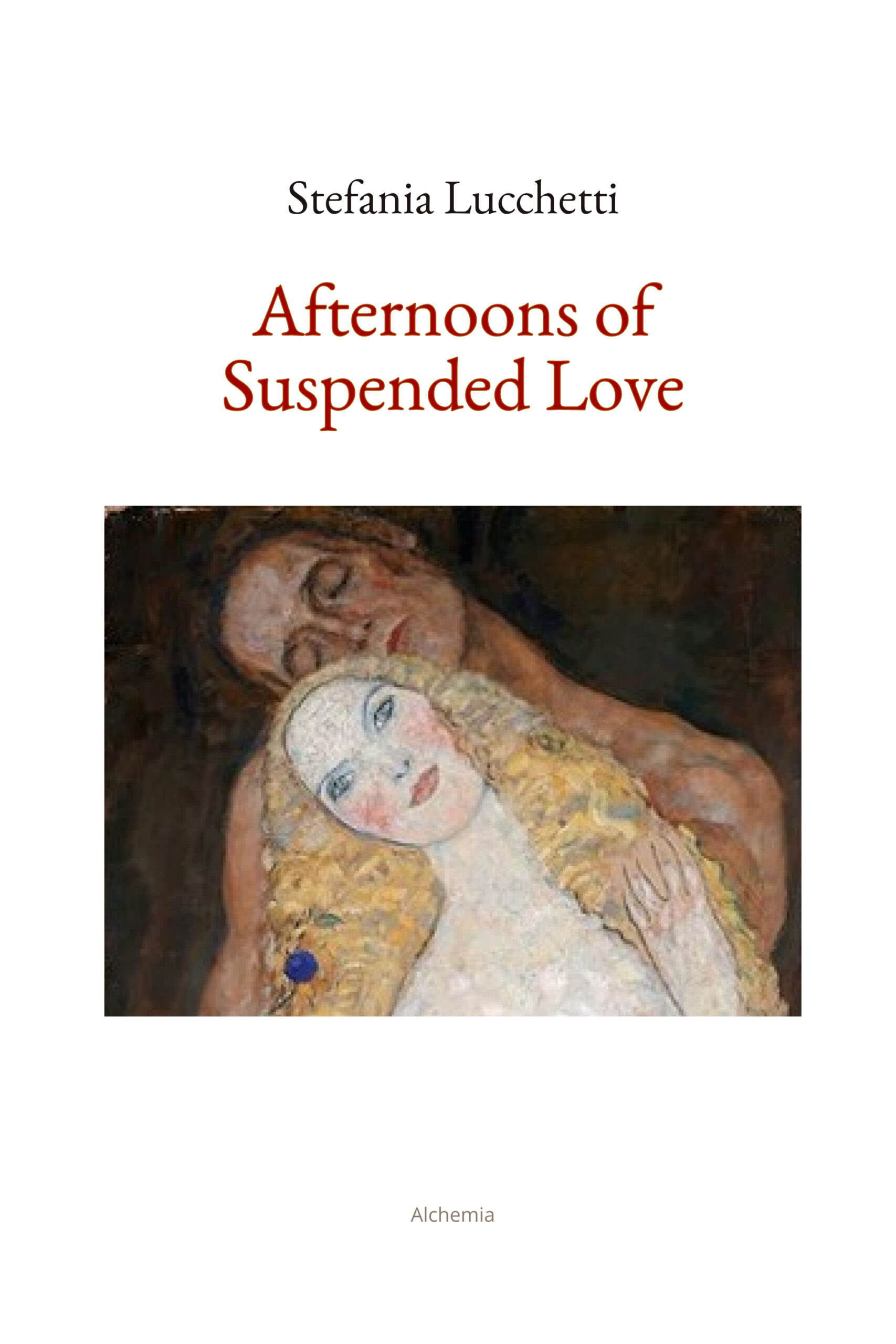
Cover art: Adam and Eve, Gustav Klimt 1917 (Belvedere Museum, Vienna)
Afternoons of Suspended Love, by Italian contemporary poet Stefania Lucchetti is a bilingual (Italian and English side by side) book of love poems dedicated to marriage: not as an institution, but as a living encounter between two individuals who choose one another every day.
Afternoons of Suspended Love: A Celebration of Married Love
The poems included in this collection narrate the many faces of love: desire and tenderness, passion and irritation, ecstasy and vulnerability. They affirm that enduring love is not the opposite of passion; it is its deepest fulfilment.
The title suggests a pause in time, a depiction of an afternoon when the two lovers find themselves alone again after some time, but there is nothing static about these poems. They pulse with the energy of lovers who continue to discover one another, whose intimacy deepens rather than fades, and whose shared life becomes a source of constant renewal. Some poems are sensual and unabashedly passionate; others explore the emotional and spiritual dimensions of marriage. Together, they offer a portrait of love as a force that embraces body, heart, and soul.
The collection rejects the notion that marriage marks the end of romantic love. On the contrary, it proposes that marriage can become the privileged space where desire matures without losing its fire, where passion acquires depth through commitment, and where intimacy becomes an art cultivated over time.
Gustav Klimt’s Adam and Eve
The choice of Gustav Klimt’s Adam and Eve for the cover was not accidental. Few painters have expressed with such intensity the union of eroticism, beauty, and spiritual intimacy.
Klimt’s Adam and Eve is far more than a reinterpretation of the biblical narrative. It presents the first man and woman as archetypes of human love, standing at the beginning of every love story. Eve, luminous and self-possessed, dominates the composition with confidence and the expression of power and erotic force, while Adam appears drawn toward her in contemplation and desire. Their proximity evokes both physical attraction and emotional communion, suggesting that love is born from the meeting of two complete yet complementary persons.
The painting also reflects Klimt’s lifelong fascination with the inseparability of sensuality and transcendence. Gold, colour, ornament, and the delicate modelling of the human body create an atmosphere in which erotic love is neither diminished nor vulgarised. Instead, it is elevated as one of the highest expressions of our humanity.
This vision resonates deeply with Afternoons of Suspended Love. The poems embrace the physical dimension of love without apology, because genuine passion is never divorced from tenderness, trust, and mutual self-giving. Marriage is portrayed not as the domestication of desire but as the place where desire finds its fullest and most enduring expression.
Poetry and Painting
Poetry and painting have always shared the power to reveal what ordinary language cannot fully express. Klimt’s Adam and Eve announces the emotional landscape of the poems inviting the reader to savour a world where love is real, radiant, naked, embodied, vulnerable, erotic and triumphant.
The dialogue between image and word is deliberate. Both seek to celebrate the mystery of two people who recognise one another, surrender to one another, and discover, through love, a deeper understanding of themselves.
An Invitation to the Reader
Afternoons of Suspended Love is an invitation to rediscover married love in all its richness through poetry – which is one of the most powerful languages through which love may speak. If these poems remind readers of the joy, longing, and inexhaustible wonder of loving another person completely, they will have achieved their purpose.


