
Penelope the Strategist: a Legal Perspective on Penelope
Stefania Lucchetti
© Stefania Lucchetti 2026
All rights reserved – This article can be linked to and mentioned but not copied
Penelope has accompanied me for much of my life. As a young reader, I devoured mythology in all forms. I encountered her as a young actress as I portrayed her in a stage performance.
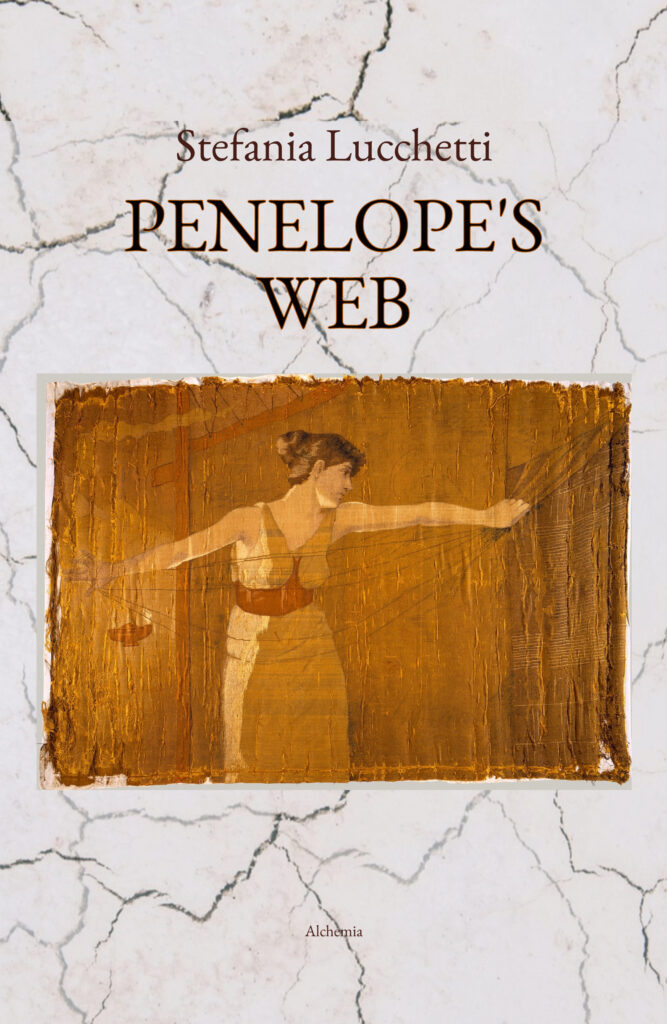 Decades later, I returned to her as a poet, dedicating an entire collection, Penelope’s Web, to her voice and to the many forms of identity, thought and intelligence of the voices of each mythological figure. Over the years I have thought about Penelope from literary, philosophical and deeply personal perspectives. Only recently did another question begin to occupy my thoughts.
As a lawyer, I found myself wondering not whether Penelope believed Odysseus would return, nor whether she remained faithful to him, but what obligations she believed herself to be under. What legal and political framework shaped her decisions? What responsibilities did she understand herself to bear towards her absent husband, her son, the royal household and the kingdom of Ithaca? And what would have been the consequences if she did not fulfil them?
The question is more difficult than it first appears.
Unlike Mesopotamia, which preserved legal collections such as the Code of Hammurabi, Mycenaean Greece has left no comparable body of legislation. The Linear B tablets reveal a sophisticated administrative world concerned with landholding, labour, taxation and palace economy, but they tell us almost nothing about marriage, inheritance or the legal position of a wife whose husband had disappeared for a decade. Matters become still more complicated because Homer wrote several centuries after the collapse of the Mycenaean palaces. The society represented in the Odyssey belongs neither entirely to the Bronze Age nor entirely to Homer’s own time. It is a literary world in which institutions, customs and memories from different historical periods coexist.
The absence of a surviving legal code does not prevent legal inquiry; but it certainly changes its method. Instead of statutes, we must read conduct. Instead of judicial decisions, we examine expectations. The poem reveals what its characters believe they may do, what they fear doing and what consequences they anticipate. Comparative evidence from neighbouring civilizations may illuminate similar legal questions − inheritance, dowry, succession, absent husbands and the continuity of the household – but it cannot tell us what Homer regarded as law. The Odyssey itself therefore becomes our principal witness.
When the poem opens, Penelope occupies a position of extraordinary uncertainty. Odysseus has been absent for twenty years, yet no one can say with certainty that he is dead. Telemachus is the legitimate heir, but he has not yet acquired the authority necessary to secure either his inheritance or the kingdom. More than a hundred aristocrats consume the resources of the royal household while urging Penelope to choose a new husband, a decision that would determine not only her own future but the succession to the throne, the ownership of the estate and the continuity of Odysseus’ oikos.
From a legal perspective, almost every available course of action carries irreversible consequences. If Odysseus is alive, remarriage fundamentally alters the legitimacy of the royal house. If he is dead, refusing to remarry prolongs a constitutional vacuum. Penelope has neither the military authority to expel the suitors nor reliable evidence upon which to declare her husband dead. Abandoning the palace would mean relinquishing the very household whose preservation appears to define her role. Also, the choice of abandoning the palace would have entailed her return – as a middle-aged woman – to her father’s house.
Later tradition adds an intriguing detail to Penelope’s earlier life. Pausanias (Description of Greece 3.20.10–11.) recounts that after her marriage, her father Icarius urged Odysseus to remain in Sparta rather than take his daughter to Ithaca. When Odysseus refused, Icarius followed the departing couple, repeatedly imploring Penelope to stay. Only when she silently drew her veil over her face − a gesture understood as choosing her husband over her father − did he abandon his pursuit and return home. The episode has traditionally been read as an illustration of modesty. It may also reveal something about the legal and emotional significance of marriage in the ancient world. Marriage did not merely unite two individuals; it transferred a woman from one oikos to another. Read in this light, the anecdote captures the tensions surrounding that transfer and suggests that Penelope’s earliest recorded decision already concerned competing loyalties between two households. But also, it may also suggest that Penelope was not willing to go back to her father’s house, as she would have been in a position of subordinance and control.
Seen against this background, the famous weaving of Laertes’ shroud acquires a different significance. It is often interpreted primarily as a symbol of fidelity. It certainly is that. Yet it also performs a practical function: the weaving prevents others from forcing a decision before the relevant facts are known. Every day spent weaving preserves possibilities that would disappear the moment Penelope accepted one of the suitors. The web is therefore more than a deception: it is a means of governing uncertainty.
Lawyers are familiar with the distinction between decisions that may later be corrected and those that cannot. the difference often determines whether action should be taken at all. Penelope’s conduct reflects a similar mode of reasoning. She does not postpone decisions because she cannot make them; she postpones those decisions whose consequences cannot be undone once new information emerges.
One episode illustrates this particularly well. In Book 18, Athena inspires Penelope to appear before the suitors and enhances her beauty before she enters the hall. What follows is one of the most sophisticated political scenes in the poem: Penelope reminds the suitors that honourable men seeking a bride do not enrich themselves at another household’s expense; they bring gifts. Without confrontation, she persuades the men who are recklessly exhausting the resources of the palace to replenish them according to the customs they themselves acknowledge. Athena creates the occasion, but the judgement belongs to Penelope. It is striking that throughout the Odyssey Athena rarely instructs Penelope in the manner she instructs Telemachus or collaborates strategically with Odysseus. She alters circumstances, sends dreams, creates opportunities, yet Penelope is generally left to determine for herself how those opportunities should be used.
Perhaps this explains why I have gradually come to think of Penelope less as a symbol of fidelity than as one of Homer’s most accomplished political and strategic minds. She understands that uncertainty is itself a condition requiring governance, she recognises that time can be managed, that information has value, and that decisions acquire their significance not only from the intentions behind them but from the moment at which they are taken. These are not merely the qualities of a faithful wife. They are the habits of someone entrusted with preserving a household, a dynasty, the possibility of restoring an order that has not yet entirely disappeared and ultimately (and probably most importantly) also her freedom and her status as queen.
© Stefania Lucchetti 2026
All rights reserved
This article can be linked to and mentioned but not copied