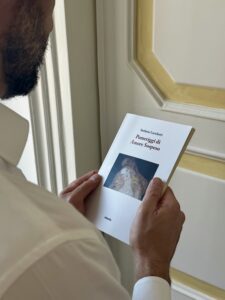
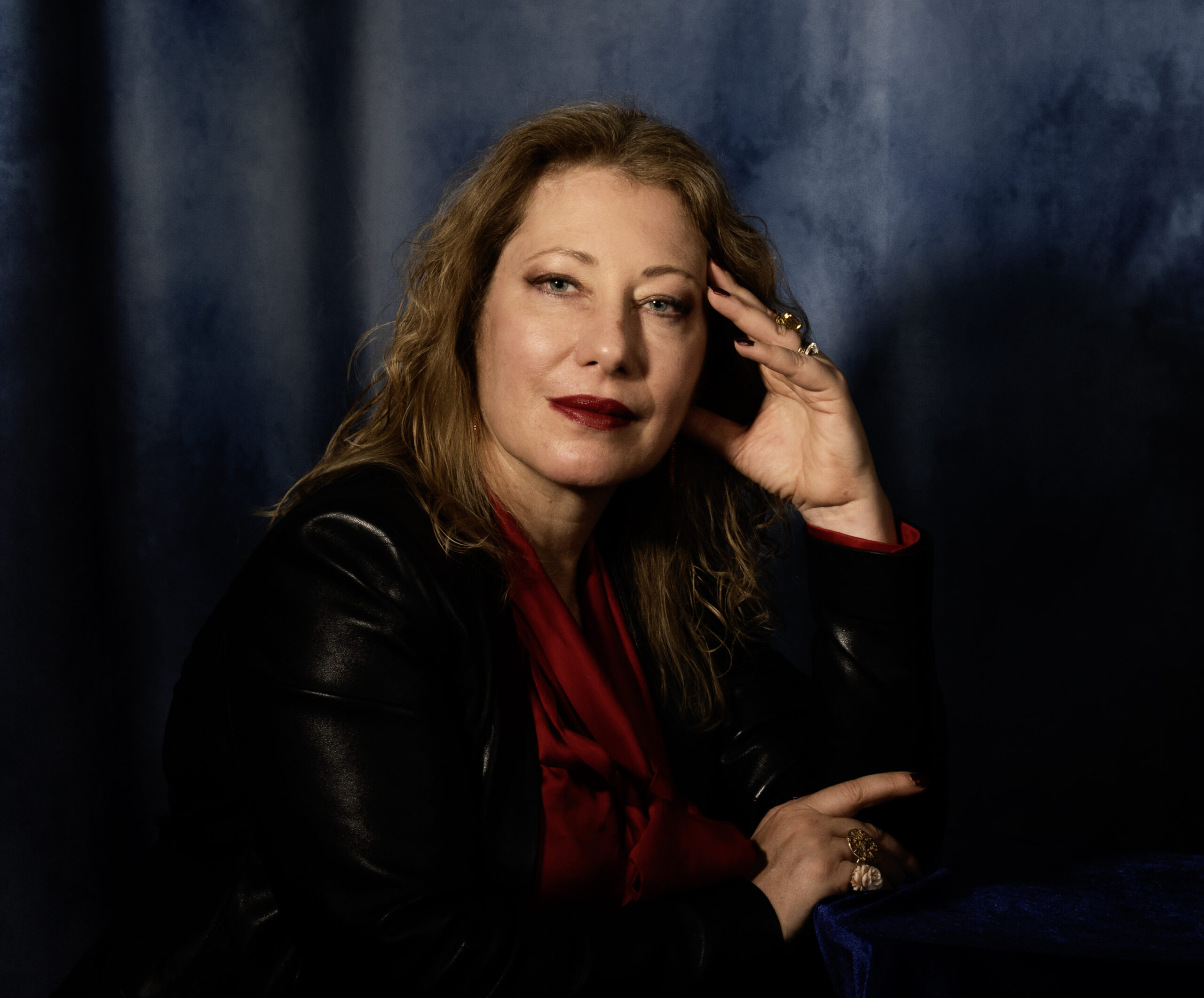
Photo: Stefania Lucchetti, portrait by Italian art photographer Emma Terenzio
Sea and thought
For many years now – ever since my work evolved into an intellectual and entrepreneurial vocation – I have spent July by the sea with my children. It is a magical time for them, and despite the inevitable fatigue, I cherish its beauty. Alongside natural beauty, however, I continue to feel the need for my intellectual life. Today, much of that life unfolds in cyberspace: through reading, writing, research, dialogue, and projects that take shape in digital environments. I do not see these two dimensions as being in conflict. Rather, I feel the need to keep them in balance.
In The Bricks of the New Babel: Identity, Language, and the Ethics of Digital Citizenship, I suggest that cyberspace should be understood not merely as a technological tool, but as a genuine sphere of human action. It is a place where we construct knowledge, develop ideas, build relationships, create culture, and participate in civic life. It is not an artificial elsewhere; it is one of the environments in which human experience now unfolds.
As I watch my children playing in the sea, I notice that my mind continues to work almost effortlessly. One idea connects to something I have read; a conversation gives rise to a new reflection; an image becomes the starting point for a page yet to be written. I do not experience this movement between contemplation and lived experience as a distraction, but as a form of continuity. Experience nourishes thought, and thought, in turn, gives meaning to experience.
I believe that one of the greatest challenges of our time is precisely this: learning to inhabit different environments consciously, without assuming that one is more authentic than another. A beach, a library, a theatre stage, a digital platform, or an online community are different settings, yet each can become a place where our humanity is expressed and cultivated.
For this reason, I do not see these days by the sea as an interruption of my intellectual work, but as one of the conditions that make it possible. Thought does not emerge apart from life; it grows from within what we live each day. And today our lives are shaped as much in physical places as they are in cyberspace—a realm that is not simply a technology, but one of the territories where relationships, culture, and citizenship take form in the twenty-first century.
Some Reflections on Women in Philosophy
When we think of the history of philosophy, names such as Plato, Aristotle, Descartes, Kant, or Nietzsche immediately come to mind. Almost all of them are men. From this, there arises the culturally and socially shaped perception that there were no women philosophers. Yet, much as with women poets, their apparent absence has far more to do with philosophical textbooks and the traditional canon than with the actual history of thought.
Women have engaged in philosophical inquiry since antiquity, even though their contributions have often been overlooked or marginalized. In the Symposium, Plato introduces the figure of Diotima of Mantinea, presenting her as Socrates’ teacher in the philosophy of love. Whether she was a historical person or a literary creation, her presence testifies to the importance Plato attributed to a female voice in philosophical reflection. Alongside this figure we find historically documented thinkers such as Hypatia of Alexandria, a central figure of the Neoplatonic school of Alexandria and one of the most distinguished intellectuals of Late Antiquity. In later centuries we encounter authors and philosophers such as Christine de Pizan, Mary Wollstonecraft, Hannah Arendt, and Simone de Beauvoir. Their marginalization resulted not only from women’s exclusion from higher education, universities, and academic institutions, but also from the ways in which the philosophical canon was constructed and transmitted over the centuries.
Women philosophers have also played an important role in bringing to the center of philosophical inquiry subjects that had long remained relatively marginal within the dominant tradition. Among these are the family, relationships of care, motherhood, interdependence, and everyday life. While much of the philosophical tradition has focused on knowledge, politics, justice, and universal principles, many women thinkers have shown that the domestic sphere and relationships of care are equally fundamental for understanding ethics, freedom, justice, and human relationships. Contemporary authors such as Carol Gilligan, whose work profoundly influenced the ethics of care, and philosophers such as Martha Nussbaum have drawn attention to relational themes – including vulnerability and interdependence – as central concerns of moral philosophy.
This is not to suggest that women philosophers speak only about the family, nor that men have ignored these subjects altogether. Rather, women’s distinct historical experience has often brought to light questions that remained at the margins of mainstream philosophy for centuries. Rediscovering women philosophers, therefore, is not simply a matter of adding a few female names to an already established list. It requires expanding our understanding of what philosophy itself has been—and what it can be.
The history of philosophy is not, after all, the history of an exclusively male mode of thought. It is the history of a tradition that, for a long time, rendered many of its female protagonists less visible. Recovering the voices of women philosophers today means restoring an essential part of humanity’s intellectual heritage and recognizing that philosophy has always been richer, more diverse, and more plural than the traditional canon has led us to believe.