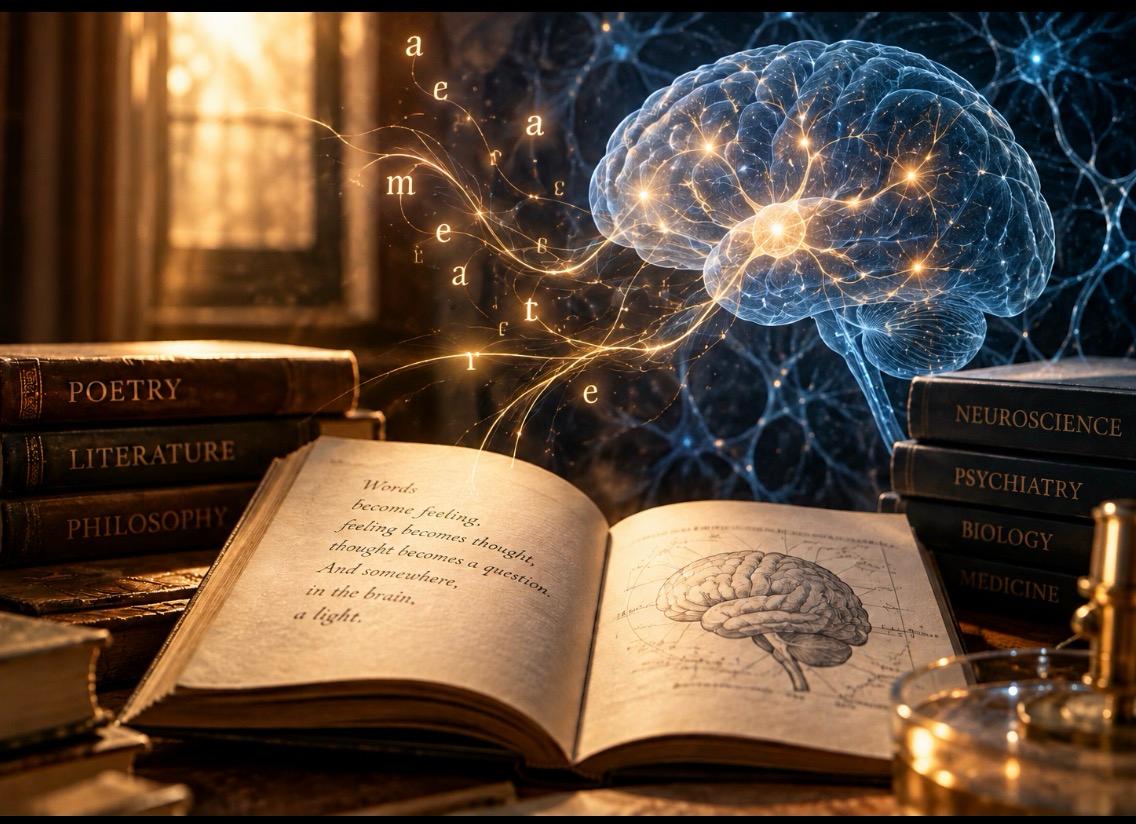
How a childhood fascination with words and feeling led Karl Deisseroth from poetry to the human brain, and eventually to the 2026 Nobel Prize in Medicine
Stefania Lucchetti
© Stefania Lucchetti 2026
All rights reserved – This article can be linked to and mentioned but not copied
On 5 October 2026, Karl Deisseroth was awarded the Nobel Prize in Physiology or Medicine, together with Peter Hegemann and Georg Nagel, for discoveries that led to optogenetics: a revolutionary technique that allows scientists to switch the activity of specific nerve cells on and off using light. Stanford News
It sounds like the culmination of a life devoted to science, yet, when Deisseroth is asked where his fascination with the brain began, his answer takes us somewhere rather different.
It began with poetry.
Long before he became a psychiatrist, neuroscientist and professor at Stanford University, Deisseroth was a child fascinated by books. He read voraciously, he loved literature and poetry, and he was very introspective. He started thinking about a most interesting question: how can a sequence of words on a page produce an emotion inside another human being.
“I was curious about how words and sentences could make me feel,” he recalled in a 2021 interview, “and I was interested in the communication between words and the brain and feelings.”
That question eventually became a scientific one: could feelings be understood? Could we understand what happens in the brain when something as immaterial as language moves us?
He stated in an interview with Yeka Aponte published on PubMed Central (PMC)[1] .
Childhood fascination with poetry was remarkably intense. Deisseroth has described writing as his “first love and vocation” and said that he originally wanted to become a writer. At one point, according to an interview in The Guardian, he was so absorbed in reading Gerard Manley Hopkins while riding his bicycle that he crashed[2].
There is another revealing story from his childhood. In an interview in The New Yorker, he revealed that in third grade, his teacher asked the class to choose a poem and memorize it. Deisseroth looked at Robert Frost’s “The Road Not Taken” and almost immediately announced that he was ready to recite it. His teacher did not believe him. She began giving him other poems to look at briefly and discovered that he could remember those too[3].
He was clearly a child with an unusual memory. Yet memory alone does not explain his relationship with poetry. What interested him was the mysterious mechanism through which language creates experience.
Years later, speaking with neuroscientist Andrew Huberman, Deisseroth returned to that early fascination. He remembered his “deep love of poetry, and stories,” and his amazement at the way words could make him feel something through their rhythm and their arrangement, sometimes independently of their dictionary meanings.
At the end of that part of their conversation, Huberman observed:
“It all started with poetry.”
Deisseroth replied:
“And it started with poetry.”[4]
In the same interview, Deisseroth revealed that Jorge Luis Borges was among the writers who influenced him most profoundly during childhood and high school. The precision, mystery and philosophical dimension of Borges’s writing fascinated him.
Gerard Manley Hopkins remained another important presence. Deisseroth would later describe scientific and literary understanding as capable of meeting in unexpected ways. In the profile in The New Yorker already mentioned earlier, he spoke of writing as another method of trying to reach the truth − using words, images and ideas, sometimes approaching reality from unusual directions.
The distinction between scientific and literary curiosity consequently becomes difficult to maintain in his story. Both emerge from the same impulse: the desire to understand experience.
Deisseroth acquired the scientific tools with which he could approach the questions that had fascinated him as a child. At Harvard he studied biochemical sciences. He then entered Stanford’s MD-PhD program, earning a doctorate in neuroscience and subsequently his medical degree. During his final year of medical school, a rotation in psychiatry changed the direction of his career[5].
Psychiatry confronted him with human experiences whose physical origins remained elusive. A person could experience a profoundly altered emotional or perceptual reality while conventional medicine still struggled to explain what was happening inside the brain.
The old question returned in another form.
What creates a feeling?
The scientific path that followed would eventually contribute to one of the most important developments in modern neuroscience. Optogenetics uses light-sensitive proteins to make selected neurons responsive to light. Researchers can then activate or suppress particular nerve cells with extraordinary precision and observe what happens to behaviour, perception and other brain functions.
The discoveries behind the technique involved several scientists. Peter Hegemann and Georg Nagel’s research on light-sensitive proteins provided crucial foundations; Deisseroth and his laboratory demonstrated how these molecular tools could be used to control neurons in mammalian brains. Their combined work transformed the ability of neuroscientists to investigate neural circuits[6]. In 2026, that work brought Deisseroth, Hegemann and Nagel the Nobel Prize.
As a poet, this story thrills me.
We tend to place poetry and science at opposite ends of intellectual life. One deals with metaphor, ambiguity, rhythm and subjective experience; the other with measurement, experiment, evidence and reproducibility.
Deisseroth’s life makes that division considerably less convincing. The question that animated his scientific career was already present in his experience as a reader: How does language become feeling? It was poetry who provided him with the question which he later explored with a neuroscientific explanation.
I have always felt that poetry reaches very deep into the mechanisms of human experience. A poem can draw our attention toward phenomena for which we do not yet possess an adequate vocabulary. It can identify an experience before we understand its mechanism. It can make us notice something about consciousness, memory, time, grief, desire or identity.
Deisseroth’s story is beautiful: a child reading poetry became fascinated by the extraordinary fact that words could alter what was happening inside him. He took that fascination seriously. He followed it into medicine, psychiatry and neuroscience, all the way down to the individual circuits of the brain. It is almost vertiginous and magical: from a poem on a page to neurons illuminated by light.
We sometimes speak about poetry as though it were an embellishment of human life, something precious perhaps, yet peripheral. I experience it very differently. Poetry touches some of the most fundamental questions of consciousness: why we feel, how we remember, how language changes us, how one human mind can enter the experience of another through words.
Deisseroth began asking those questions as a child because of poetry. Decades later, they helped lead him towards discoveries worthy of a Nobel Prize.
[1] Neurophotonics — “Illuminating the brain: an interview with Karl Deisseroth” – 2021 Nov 12;8(4):040401. doi: 10.1117/1.NPh.8.4.040401
[2] The Guardian — “Neuroscientist Karl Deisseroth: Coronavirus has changed us all”
[3] https://www.newyorker.com/magazine/2015/05/18/lighting-the-brain
[4] https://www.hubermanlab.com/episode/karl-deisseroth-understanding-and-healing-the-mind
[5] https://med.stanford.edu/news/all-news/2021/09/karl-deisseroth-lasker-award.html
[6] https://www.reuters.com/business/healthcare-pharmaceuticals/deisseroth-hegemann-nagelwin-2026-nobel-medicine-prize-2026-10-05/
© Stefania Lucchetti 2026
All rights reserved
This article can be linked to and mentioned but not copied